Difference between revisions of "Paiste Formula 602"
m |
m |
||
| (62 intermediate revisions by 4 users not shown) | |||
| Line 2: | Line 2: | ||
== Formula 602 == | == Formula 602 == | ||
<div style="float:right">__TOC__</div> | <div style="float:right">__TOC__</div> | ||
| − | [[File:602 logo.jpg|thumb|right| | + | [[File:602 logo Blue mod.jpg|thumb|right|450px|Formula 602 logo]] |
| − | [[File:Fo 602.png|thumb|right| | + | [[File:Fo 602.png|thumb|right|450px|]] |
| − | '''Introduction:''' | + | [[File:1985 602 catalog.jpg|thumb|right|450px|]] |
| + | '''Introduction:''' 1962/63ish (based on advertising and catalogs)<br> | ||
'''Discontinued:''' 1994 (based on serial numbers) then reissued 2011 to present<br> | '''Discontinued:''' 1994 (based on serial numbers) then reissued 2011 to present<br> | ||
| − | '''Background:''' | + | '''Background:''' One of the world’s most revered and legendary cymbal lines in history, renown and loved for its fine, delicate musical tone.<br> |
| − | + | Robert Paiste had been experimenting with cymbals made of B20 bell bronze starting in 1957, this (new to Paiste) B20 alloy first came onto the market under the name "SUPER FORMULA 602" the predecessor to the Formula 602. It is believed that Robert spent a couple of years refining the production process ('57-'59), sound characteristics and model names and sizes, then we think the "Super Formula" series ran to about 1962. Evidence shows that the Formula 602 series became available in 1962 and was produced until Paiste's B20 supplier Swissmetal ran into financial difficulties and stopped production of blanks in 1994.<br> | |
| − | + | '''Innovation:''' Second B20 cymbal made by Paiste, the Formula 602 line also saw the introduction of the [[Paiste Sound Edge Hi-Hat|Sound Edge Hi-Hat]], the [[Paiste Flatride|Flatride]], [[Paiste China Type|China Type]] with a Turkish bell, [[Paiste Splash|Splash]] and [[Paiste Bell|Bell]]. <br> | |
| − | |||
| − | '''Innovation:''' | ||
'''Alloy:''' [[Identify_Your_Paistes#B20_Alloy|B20 Bronze]], also known as "Bell Bronze".<br> | '''Alloy:''' [[Identify_Your_Paistes#B20_Alloy|B20 Bronze]], also known as "Bell Bronze".<br> | ||
'''Quality:''' Professional<br> | '''Quality:''' Professional<br> | ||
'''Offered as:''' [[Paiste Formula 602#Formula 602|Formula 602]] - [[Paiste Formula 602#Formula 602 Modern Essentials|Formula 602 Modern Essentials]]<br> | '''Offered as:''' [[Paiste Formula 602#Formula 602|Formula 602]] - [[Paiste Formula 602#Formula 602 Modern Essentials|Formula 602 Modern Essentials]]<br> | ||
| − | '''Production:''' | + | '''Production:''' Manually machine hammered, fine tuned with hand hammering and hand lathed B20 bronze. <br> |
| − | '''Applications:''' | + | '''Applications:''' Most volume settings • Low to medium loud settings • especially well-suited for recording, live • Jazz, Fusion, Blues, Pop and Rock, Country, Folk, acoustic music.<br> |
| − | + | '''Users:''' Professional musicians, refined drummers and sound specialists with precise requirements that need a fully developed character in their cymbal sound<br> | |
| − | + | <b>Late 1960's early 1970's formula 602 users:</b> [https://youtu.be/axEK3x5KIYc?t=30 '''Clive Bunker playing a shiny new set of 602's in 1970 @ the isle of Wight festival.'''] | |
| − | '''Users:''' Professional musicians | + | [[File:602 players.jpg|thumb|right|450px|Formula 602 Players]] |
'''Sound:''' | '''Sound:''' | ||
* Musical, transparent, beautiful, rich, colorful, full, clear, expressive sound • The model range features everything from particularly delicate, well balanced and sensitive to expressive, potent and powerful and projective qualities | * Musical, transparent, beautiful, rich, colorful, full, clear, expressive sound • The model range features everything from particularly delicate, well balanced and sensitive to expressive, potent and powerful and projective qualities | ||
* Warm, silvery, mellow, cool, light, fine, precise and controlled • Cymbals with clarity and retro vintage character combined with a velvety, sensitive, very responsive feel. (4)<br> | * Warm, silvery, mellow, cool, light, fine, precise and controlled • Cymbals with clarity and retro vintage character combined with a velvety, sensitive, very responsive feel. (4)<br> | ||
| − | * | + | * Formula 602 sounds are very precise, very clear and very pure. They are suited to acoustic music, jazz, classical performances and recording. Only a delicate touch is required to produce their distinctive, cool and natural response. (1) |
| − | + | * Forged from the legendary «602 Bronze» (CuSn20), handcrafted from start to finish by highly skilled Swiss craftsmen, Formula 602 Classic Sounds cymbals produce a true, pure sound of unique clarity and consistency.<br> | |
| − | |||
| − | |||
| − | |||
=== Formula 602 Models in Production === | === Formula 602 Models in Production === | ||
==== Rides ==== | ==== Rides ==== | ||
| Line 38: | Line 34: | ||
* '''[[Paiste Thin Crash|Thin Crash]] - [[Paiste Formula 602 16" Thin Crash|16"]] [[Paiste Formula 602 17" Thin Crash|17"]] [[Paiste Formula 602 18" Thin Crash|18"]] [[Paiste Formula 602 19" Thin Crash|19"]] [[Paiste Formula 602 20" Thin Crash|20"]] [[Paiste Formula 602 22" Thin Crash|22"]]<br> | * '''[[Paiste Thin Crash|Thin Crash]] - [[Paiste Formula 602 16" Thin Crash|16"]] [[Paiste Formula 602 17" Thin Crash|17"]] [[Paiste Formula 602 18" Thin Crash|18"]] [[Paiste Formula 602 19" Thin Crash|19"]] [[Paiste Formula 602 20" Thin Crash|20"]] [[Paiste Formula 602 22" Thin Crash|22"]]<br> | ||
==== Hi-Hats ==== | ==== Hi-Hats ==== | ||
| + | [[Paiste WT Formula 602 Hi-Hats|Weight Table]]<br> | ||
* '''[[Paiste Heavy Hi-Hat|Heavy Hi-Hat]] - [[Paiste Formula 602 14" Heavy Hi-Hat|14"]] [[Paiste Formula 602 15" Heavy Hi-Hat|15"]]<br> | * '''[[Paiste Heavy Hi-Hat|Heavy Hi-Hat]] - [[Paiste Formula 602 14" Heavy Hi-Hat|14"]] [[Paiste Formula 602 15" Heavy Hi-Hat|15"]]<br> | ||
* '''[[Paiste Medium Hi-Hat|Medium Hi-Hat]] - [[Paiste Formula 602 14" Medium Hi-Hat|14"]] [[Paiste Formula 602 15" Medium Hi-Hat|15"]]<br> | * '''[[Paiste Medium Hi-Hat|Medium Hi-Hat]] - [[Paiste Formula 602 14" Medium Hi-Hat|14"]] [[Paiste Formula 602 15" Medium Hi-Hat|15"]]<br> | ||
| Line 43: | Line 40: | ||
==== Splashes (& Bells) ==== | ==== Splashes (& Bells) ==== | ||
* '''[[Paiste Heavy Bell|Heavy Bell]] - [[Paiste Formula 602 13" Heavy Bell|13"]]<br> | * '''[[Paiste Heavy Bell|Heavy Bell]] - [[Paiste Formula 602 13" Heavy Bell|13"]]<br> | ||
| − | === <b>Discontinued Models & Sizes | + | === <b>Discontinued Models & Sizes</b> === |
==== Rides ==== | ==== Rides ==== | ||
* '''[[Paiste Dark Ride|Dark Ride]] - [[Paiste Formula 602 22" Dark Ride|22"]] <br> | * '''[[Paiste Dark Ride|Dark Ride]] - [[Paiste Formula 602 22" Dark Ride|22"]] <br> | ||
| Line 49: | Line 46: | ||
* '''[[Paiste Flatride Medium|Flatride Medium]] - [[Paiste Formula 602 14" Flatride Medium|14"]] [[Paiste Formula 602 16" Flatride Medium|16"]] [[Paiste Formula 602 18" Flatride Medium|18"]] [[Paiste Formula 602 22" Flatride Medium|22"]]<br> | * '''[[Paiste Flatride Medium|Flatride Medium]] - [[Paiste Formula 602 14" Flatride Medium|14"]] [[Paiste Formula 602 16" Flatride Medium|16"]] [[Paiste Formula 602 18" Flatride Medium|18"]] [[Paiste Formula 602 22" Flatride Medium|22"]]<br> | ||
* '''[[Paiste Flatride Thin|Flatride Thin]] - [[Paiste Formula 602 14" Flatride Thin|14"]] [[Paiste Formula 602 16" Flatride Thin|16"]] [[Paiste Formula 602 24" Flatride Thin|24"]]<br> | * '''[[Paiste Flatride Thin|Flatride Thin]] - [[Paiste Formula 602 14" Flatride Thin|14"]] [[Paiste Formula 602 16" Flatride Thin|16"]] [[Paiste Formula 602 24" Flatride Thin|24"]]<br> | ||
| − | * '''[[Paiste Heavy|Heavy]] - [[Paiste Formula 602 10" Heavy|10"]] [[Paiste Formula 602 11" Heavy|11"]] [[Paiste Formula 602 12" Heavy|12"]] [[Paiste Formula 602 13" Heavy|13"]] [[Paiste Formula 602 14" Heavy|14"]] [[Paiste Formula 602 15" Heavy|15"]] [[Paiste Formula 602 17" Heavy|17"]] [[Paiste Formula 602 19" Heavy|19"]] [[Paiste Formula 602 21" Heavy|21"]] [[Paiste Formula 602 22" Heavy|22"]] [[Paiste Formula 602 23" Heavy|23"]] [[Paiste Formula 602 24" Heavy|24"]] [[Paiste Formula 602 26" Heavy|26"]]<br> | + | * '''[[Paiste Heavy|Heavy]] - [[Paiste Formula 602 8" Heavy|8"]] [[Paiste Formula 602 10" Heavy|10"]] [[Paiste Formula 602 11" Heavy|11"]] [[Paiste Formula 602 12" Heavy|12"]] [[Paiste Formula 602 13" Heavy|13"]] [[Paiste Formula 602 14" Heavy|14"]] [[Paiste Formula 602 15" Heavy|15"]] [[Paiste Formula 602 17" Heavy|17"]] [[Paiste Formula 602 19" Heavy|19"]] [[Paiste Formula 602 21" Heavy|21"]] [[Paiste Formula 602 22" Heavy|22"]] [[Paiste Formula 602 23" Heavy|23"]] [[Paiste Formula 602 24" Heavy|24"]] [[Paiste Formula 602 26" Heavy|26"]]<br> |
* '''[[Paiste Medium Ride|Medium Ride]] - [[Paiste Formula 602 16" Medium Ride|16"]] [[Paiste Formula 602 17" Medium Ride|17"]] [[Paiste Formula 602 18" Medium Ride|18"]] [[Paiste Formula 602 19" Medium Ride|19"]] [[Paiste Formula 602 21" Medium Ride|21"]]<br> | * '''[[Paiste Medium Ride|Medium Ride]] - [[Paiste Formula 602 16" Medium Ride|16"]] [[Paiste Formula 602 17" Medium Ride|17"]] [[Paiste Formula 602 18" Medium Ride|18"]] [[Paiste Formula 602 19" Medium Ride|19"]] [[Paiste Formula 602 21" Medium Ride|21"]]<br> | ||
| − | * '''[[Paiste Space Sound Medium|Space Sound Medium]]- [[Paiste Formula 602 18" Space Sound Medium|18"]] | + | * '''[[Paiste Space Sound Medium|Space Sound Medium]] - [[Paiste Formula 602 18" Space Sound Medium|18"]] [[Paiste Formula 602 20" Space Sound Medium|20"]]<br> |
| − | * '''[[Paiste Space Sound Thin|Space Sound Thin]] - [[Paiste Formula 602 18" Space Sound Thin|18"]] | + | * '''[[Paiste Space Sound Thin|Space Sound Thin]] - [[Paiste Formula 602 18" Space Sound Thin|18"]] [[Paiste Formula 602 20" Space Sound Thin|20"]]<br> |
==== Crashes ==== | ==== Crashes ==== | ||
* '''[[Paiste Medium|Medium]] - [[Paiste Formula 602 10" Medium|10"]] [[Paiste Formula 602 11" Medium|11"]] [[Paiste Formula 602 12" Medium|12"]] [[Paiste Formula 602 13" Medium|13"]] [[Paiste Formula 602 14" Medium|14"]] [[Paiste Formula 602 15" Medium|15"]] [[Paiste Formula 602 21" Medium|21"]] [[Paiste Formula 602 22" Medium|22"]] [[Paiste Formula 602 23" Medium|23"]] [[Paiste Formula 602 24" Medium|24"]] [[Paiste Formula 602 26" Medium|26"]]<br> | * '''[[Paiste Medium|Medium]] - [[Paiste Formula 602 10" Medium|10"]] [[Paiste Formula 602 11" Medium|11"]] [[Paiste Formula 602 12" Medium|12"]] [[Paiste Formula 602 13" Medium|13"]] [[Paiste Formula 602 14" Medium|14"]] [[Paiste Formula 602 15" Medium|15"]] [[Paiste Formula 602 21" Medium|21"]] [[Paiste Formula 602 22" Medium|22"]] [[Paiste Formula 602 23" Medium|23"]] [[Paiste Formula 602 24" Medium|24"]] [[Paiste Formula 602 26" Medium|26"]]<br> | ||
| Line 59: | Line 56: | ||
* '''[[Paiste Thin Crash|Thin Crash]] - [[Paiste Formula 602 12" Thin Crash|12"]] [[Paiste Formula 602 13" Thin Crash|13"]] [[Paiste Formula 602 14" Thin Crash|14"]] [[Paiste Formula 602 15" Thin Crash|15"]] [[Paiste Formula 602 21" Thin Crash|21"]] [[Paiste Formula 602 24" Thin Crash|24"]] [[Paiste Formula 602 26" Thin Crash|26"]]<br> | * '''[[Paiste Thin Crash|Thin Crash]] - [[Paiste Formula 602 12" Thin Crash|12"]] [[Paiste Formula 602 13" Thin Crash|13"]] [[Paiste Formula 602 14" Thin Crash|14"]] [[Paiste Formula 602 15" Thin Crash|15"]] [[Paiste Formula 602 21" Thin Crash|21"]] [[Paiste Formula 602 24" Thin Crash|24"]] [[Paiste Formula 602 26" Thin Crash|26"]]<br> | ||
==== Hi-Hats ==== | ==== Hi-Hats ==== | ||
| + | [[Paiste WT Formula 602 Hi-Hats|Weight Table]]<br> | ||
* '''[[Paiste Extra Heavy Hi-Hat|Extra Heavy Hi-Hat]] - [[Paiste Formula 602 11" Extra Heavy Hi-Hat|11"]] [[Paiste Formula 602 12" Extra Heavy Hi-Hat|12"]] [[Paiste Formula 602 13" Extra Heavy Hi-Hat|13"]] [[Paiste Formula 602 14" Extra Heavy Hi-Hat|14"]] [[Paiste Formula 602 15" Extra Heavy Hi-Hat|15"]] <br> | * '''[[Paiste Extra Heavy Hi-Hat|Extra Heavy Hi-Hat]] - [[Paiste Formula 602 11" Extra Heavy Hi-Hat|11"]] [[Paiste Formula 602 12" Extra Heavy Hi-Hat|12"]] [[Paiste Formula 602 13" Extra Heavy Hi-Hat|13"]] [[Paiste Formula 602 14" Extra Heavy Hi-Hat|14"]] [[Paiste Formula 602 15" Extra Heavy Hi-Hat|15"]] <br> | ||
| − | * '''[[Paiste Extra Heavy Sound Edge Hi-Hat|Extra Heavy Sound Edge Hi-Hat]] - [[Paiste Formula 602 13" Extra Heavy Sound Edge Hi-Hat|13"]] [[Paiste Formula 602 15" Extra Heavy Sound Edge Hi-Hat|15"]]<br> | + | * '''[[Paiste Extra Heavy Sound Edge Hi-Hat|Extra Heavy Sound Edge Hi-Hat]] - [[Paiste Formula 602 13" Extra Heavy Sound Edge Hi-Hat|13"]] [[Paiste Formula 602 14" Extra Heavy Sound Edge Hi-Hat|14"]] [[Paiste Formula 602 15" Extra Heavy Sound Edge Hi-Hat|15"]]<br> |
* '''[[Paiste Heavy Hi-Hat|Heavy Hi-Hat]] - [[Paiste Formula 602 13" Heavy Hi-Hat|13"]]<br> | * '''[[Paiste Heavy Hi-Hat|Heavy Hi-Hat]] - [[Paiste Formula 602 13" Heavy Hi-Hat|13"]]<br> | ||
* '''[[Paiste Hi-Hat|Hi-Hat]] - [[Paiste Formula 602 13" Hi-Hat|13"]] [[Paiste Formula 602 14" Hi-Hat|14"]] [[Paiste Formula 602 15" Hi-Hat|15"]]<br> | * '''[[Paiste Hi-Hat|Hi-Hat]] - [[Paiste Formula 602 13" Hi-Hat|13"]] [[Paiste Formula 602 14" Hi-Hat|14"]] [[Paiste Formula 602 15" Hi-Hat|15"]]<br> | ||
| Line 69: | Line 67: | ||
==== Splashes (& Bells) ==== | ==== Splashes (& Bells) ==== | ||
* '''[[Paiste Bell|Bell]] - [[Paiste Formula 602 8" Bell|8"]] [[Paiste Formula 602 10" Bell|10"]] [[Paiste Formula 602 12" Bell|12"]]<br> | * '''[[Paiste Bell|Bell]] - [[Paiste Formula 602 8" Bell|8"]] [[Paiste Formula 602 10" Bell|10"]] [[Paiste Formula 602 12" Bell|12"]]<br> | ||
| − | * '''[[Paiste Heavy Bell|Heavy Bell]] - [[Paiste Formula 602 8" Heavy Bell|8"]] [[Paiste Formula 602 9" Heavy Bell|9"]] [[Paiste Formula 602 10" Heavy Bell|10"]] [[Paiste Formula 602 11" Heavy Bell|11"]] [[Paiste Formula 602 12" Heavy Bell|12 | + | * '''[[Paiste Heavy Bell|Heavy Bell]] - [[Paiste Formula 602 8" Heavy Bell|8"]] [[Paiste Formula 602 9" Heavy Bell|9"]] [[Paiste Formula 602 10" Heavy Bell|10"]] [[Paiste Formula 602 11" Heavy Bell|11"]] [[Paiste Formula 602 12" Heavy Bell|12"]]<br> |
| − | * '''[[Paiste Splash|Splash]] -[[Paiste Formula 602 10" Splash|10"]] [[Paiste Formula 602 11" Splash|11"]]<br> | + | * '''[[Paiste Splash|Splash]] - [[Paiste Formula 602 8" Splash|8"]] [[Paiste Formula 602 10" Splash|10"]] [[Paiste Formula 602 11" Splash|11"]]<br> |
==== Other ==== | ==== Other ==== | ||
| − | * '''[[Paiste Cup Chime|Cup Chime]] - [[Paiste Formula 602 8" Cup Chime|8"]] [[Paiste Formula 602 11" Cup Chime|11"]]<br> | + | * '''[[Paiste Cup Chime|Cup Chime]] - [[Paiste Formula 602 8" Cup Chime|8"]] [[Paiste Formula 602 10" Cup Chime|10"]] [[Paiste Formula 602 11" Cup Chime|11"]]<br> |
* '''[[Paiste Concert|Concert]] - [[Paiste Formula 602 17" Concert|17"]] [[Paiste Formula 602 18" Concert|18"]] [[Paiste Formula 602 19" Concert|19"]] [[Paiste Formula 602 20" Concert|20"]]<br> | * '''[[Paiste Concert|Concert]] - [[Paiste Formula 602 17" Concert|17"]] [[Paiste Formula 602 18" Concert|18"]] [[Paiste Formula 602 19" Concert|19"]] [[Paiste Formula 602 20" Concert|20"]]<br> | ||
* '''Concert Medium Weight''' - 17" 18" 19" 20" 21"<br> | * '''Concert Medium Weight''' - 17" 18" 19" 20" 21"<br> | ||
* '''Concert Medium-Heavy''' - 18" 19" 20"<br> | * '''Concert Medium-Heavy''' - 18" 19" 20"<br> | ||
* '''Concert Medium-Thin''' - 18" 19" 20"<br> | * '''Concert Medium-Thin''' - 18" 19" 20"<br> | ||
| − | * '''[[Paiste Concert Heavy|Concert Heavy]] - 17" | + | * '''[[Paiste Concert Heavy|Concert Heavy]] - 17" 18" 19" [[Paiste Formula 602 20" Concert Heavy|20"]]<br> |
| + | * '''[[Paiste Crotale|Crotale]] - [[Paiste Formula 602 Crotale 1 Octave Set|1 Octave Set]] [[Paiste Formula 602 Crotale 2 Octave Set|2 Octave Set]] [[Paiste Formula 602 Crotale 2½ Octave Set|2½ Octave Set]]<br> | ||
* '''[[Paiste Concert Sound Edge|Concert Sound Edge]] - [[Paiste Formula 602 18" Concert Sound Edge|18"]] [[Paiste Formula 602 20" Concert Sound Edge|20"]] | * '''[[Paiste Concert Sound Edge|Concert Sound Edge]] - [[Paiste Formula 602 18" Concert Sound Edge|18"]] [[Paiste Formula 602 20" Concert Sound Edge|20"]] | ||
| − | * '''[[Paiste Marching|Marching]] - [[Paiste Formula 602 | + | * '''[[Paiste Marching|Marching]] - [[Paiste Formula 602 12" Marching|12"]] [[Paiste Formula 602 13" Marching|13"]] [[Paiste Formula 602 14" Marching|14"]] [[Paiste Formula 602 15" Marching|15"]] [[Paiste Formula 602 16" Marching|16"]]<br> |
| − | * '''[[Paiste Marching Sound Edge|Marching Sound Edge]] - [[Paiste | + | * '''[[Paiste Marching Sound Edge|Marching Sound Edge]] - [[Paiste Formula 602 14" Marching Sound Edge|14"]] [[Paiste Formula 602 15" Marching Sound Edge|15"]] [[Paiste Formula 602 16" Marching Sound Edge|16"]] [[Paiste Formula 602 18" Marching Sound Edge|18"]] [[Paiste Formula 602 20" Marching Sound Edge|20"]]<br><br> |
| − | + | === Seven Sound Set === | |
| + | [[File:Paiste seven sound set advert.jpg|thumb|right|450px|1968 brochure]] | ||
| + | [[File:7 sound set.jpg|thumb|right|450px|Complete 7 sound set]] | ||
| + | '''Introduction:''' 1967<br> | ||
| + | '''Discontinued:''' 1977<br> | ||
| + | '''Background:''' The following description of the Seven Sound Set was printed in Paiste's 1969 catalog:<br> | ||
| + | "A set of seven cymbals each in a new unusual sound-color. Sound colors the demanding drummer is looking for to enrich his personal cymbal set. Particularly, the SEVEN SOUND SET enables the studio drummer to fulfill the many and often unusual sound demands involved in modern recording and studio work."<br> | ||
| + | '''Flat ride Background:''' From a 2006 Robert Paiste interview: "The Flat Ride is the first and the last cymbal that more or less came out of a gag. That was with [[Paiste Joe Morello#Joe Morello|Joe Morello]], he visited here once and at that time there were these new super thin Swiss watches, he was fascinated with his new super thin watch that he had just got. He said, "why don't you make a cymbal like that?" I wondered, what does a cymbal without a bell sound like? Well, we were making gongs, but I didn't relate to that, we built prototypes, which surprised us very much with the sound."<br> | ||
| + | The very early versions or possibly prototypes were labeled "Space Sound" in medium (confirmed) and possibly thin weight. It also believed that less than a dozen of these were made before the name changed to "Flatride"<br> | ||
| + | * '''1 [[Paiste Bell|Bell]] - [[Paiste Formula 602 8" Bell "Seven Sound Set 1"|8"]]<br> | ||
| + | * '''2 [[Paiste Splash|Splash]] - [[Paiste Formula 602 11" Splash "Seven Sound Set 2"|11"]]<br> | ||
| + | * '''3 [[Paiste Bright Ride|Bright Ride]] - [[Paiste Formula 602 17" Bright Ride "Seven Sound Set 3"|17"]]<br> | ||
| + | * '''4 [[Paiste Flatride Medium|Flatride Medium]] - [[Paiste Formula 602 18" Flatride Medium "Seven Sound Set 4"|18"]]<br> | ||
| + | : '''4 [[Paiste Flatride Thin|Flatride Thin]] - [[Paiste Formula 602 18" Flatride Thin "Seven Sound Set 4"|18"]]<br> | ||
| + | * '''5 [[Paiste Ride/Crash|Ride/Crash]] - [[Paiste Formula 602 18" Ride/Crash "Seven Sound Set 5"|18"]]<br> | ||
| + | * '''6 [[Paiste China Type|China Type]] - [[Paiste Formula 602 18" China Type "Seven Sound Set 6"|18"]]<br> | ||
| + | * '''7 [[Paiste Deep Ride|Deep Ride]] - [[Paiste Formula 602 18" Deep Ride "Seven Sound Set 7"|18"]]<br> | ||
| + | : '''7 [[Paiste Deep Ride|Deep Ride]] - [[Paiste Formula 602 20" Deep Ride "Seven Sound Set 7"|20"]]<br><br> | ||
| + | === Joe Morello Set === | ||
| + | [[File:Joe morello.jpg|thumb|right|450px|1975 Paiste profiles]] | ||
| + | '''Introduction:''' 1967ish - 1977 (based on serial numbers)<br> | ||
| + | '''Discontinued:''' 1976<br> | ||
| + | '''Background:''' "Late '65, early '66 after Ludwig took over the distribution of Formula 602's for North America, [[Paiste Joe Morello#Joe Morello|Joe Morello]] was approached by Bill Ludwig to endorse Paiste. Since Joe played and endorsed Ludwig Drums, he was the obvious choice for a signature cymbal set baring his name. Paiste catalog: "In personal collaboration with Joe Morello, this beautiful melodically coordinated set was created" A custom set of Formula 602 cymbals made to Joe's specification (the 1st. artist model!) comprising of 14" sound edge hi hats, 17", 18" and 20" sizes. Visual cues show much finer lathing and possibly different hammering compared to the standard 602's<br> | ||
| + | ==== Rides ==== | ||
| + | * '''[[Paiste Ride|Ride]] - [[Paiste Formula 602 20" Ride "Joe Morello Set"|20"]]<br> | ||
| + | ==== Crashes ==== | ||
| + | * '''[[Paiste Crash|Crash]] - [[Paiste Formula 602 17" Crash "Joe Morello Set"|17"]]<br> | ||
| + | * '''[[Paiste Crash/Ride|Crash/Ride]] - [[Paiste Formula 602 18" Crash/Ride "Joe Morello Set"|18"]]<br> | ||
| + | ==== Hi-Hats ==== | ||
| + | [[Paiste WT Formula 602 Hi-Hats|Weight Table]]<br> | ||
| + | * '''[[Paiste Hi-Hat|Hi-Hat]] - [[Paiste Formula 602 14" Hi-Hat "Joe Morello Set"|14"]]<br> | ||
| + | * '''[[Paiste Sound Edge Hi-Hat|Sound Edge Hi-Hat]] - [[Paiste Formula 602 14" Sound Edge Hi-Hat "Joe Morello Set"|14"]]<br><br> | ||
== Formula 602 Modern Essentials == | == Formula 602 Modern Essentials == | ||
| − | [[File:FORMULA602 ME Group.jpg|thumb|right| | + | [[File:FORMULA602 ME Group.jpg|thumb|right|450px|]] |
| + | [[File:Fredy 2016 drumhead mag 2.jpg|thumb|right|450px|Interview with Fredy Studer describing the development of the M.E. 602 and Vinnie Colaiuta's involvement.]] | ||
'''Introduction:''' 2013<br> | '''Introduction:''' 2013<br> | ||
'''Background:''' Forged from the legendary «602 Bronze» (CuSn20), offering a complete new wide and dynamic sound dimension, developed in close collaboration with Vinnie Colaiuta, handcrafted from start to finish by highly skilled Swiss craftsmen, conceived and executed according to Vinnie’s uncompromising sound concepts for a wide all-round application. Formula 602 Modern Essentials cymbals combine the essence of the Formula 602 Classic Sounds models – transparency and stick definition – with the richness, warmth, darkness and a bit of complexity of the Signature Traditionals series besides providing slightly more pizzazz than its Classic Sounds siblings.<br> | '''Background:''' Forged from the legendary «602 Bronze» (CuSn20), offering a complete new wide and dynamic sound dimension, developed in close collaboration with Vinnie Colaiuta, handcrafted from start to finish by highly skilled Swiss craftsmen, conceived and executed according to Vinnie’s uncompromising sound concepts for a wide all-round application. Formula 602 Modern Essentials cymbals combine the essence of the Formula 602 Classic Sounds models – transparency and stick definition – with the richness, warmth, darkness and a bit of complexity of the Signature Traditionals series besides providing slightly more pizzazz than its Classic Sounds siblings.<br> | ||
| Line 93: | Line 124: | ||
'''Sound:'''Deep, full, rich, warm, lively, silvery, dynamic, controlled and precise • Cymbals that combine clarity, consistency with deepness and warmth, yet providing a modern versatile sound character with dynamic, potent, well balanced qualities and a responsive, soft feel<br> | '''Sound:'''Deep, full, rich, warm, lively, silvery, dynamic, controlled and precise • Cymbals that combine clarity, consistency with deepness and warmth, yet providing a modern versatile sound character with dynamic, potent, well balanced qualities and a responsive, soft feel<br> | ||
==== Rides ==== | ==== Rides ==== | ||
| − | * '''[[Paiste Ride|Ride]] - [[Paiste Formula 602 Modern Essentials 20" Ride|20"]] [[Paiste Formula 602 Modern Essentials 22" Ride|22"]] [[Paiste Formula 602 Modern Essentials 24" Ride|24"]]<br> | + | * '''[[Paiste Ride|Ride]] - [[Paiste Formula 602 Modern Essentials 20" Ride|20"]] [[Paiste Formula 602 Modern Essentials 21" Ride|21"]] [[Paiste Formula 602 Modern Essentials 22" Ride|22"]] [[Paiste Formula 602 Modern Essentials 24" Ride|24"]]<br> |
==== Crashes ==== | ==== Crashes ==== | ||
* '''[[Paiste Crash|Crash]] - [[Paiste Formula 602 Modern Essentials 16" Crash|16"]] [[Paiste Formula 602 Modern Essentials 17" Crash|17"]] [[Paiste Formula 602 Modern Essentials 18" Crash|18"]] [[Paiste Formula 602 Modern Essentials 19" Crash|19"]] [[Paiste Formula 602 Modern Essentials 20" Crash|20"]] [[Paiste Formula 602 Modern Essentials 22" Crash|22"]]<br> | * '''[[Paiste Crash|Crash]] - [[Paiste Formula 602 Modern Essentials 16" Crash|16"]] [[Paiste Formula 602 Modern Essentials 17" Crash|17"]] [[Paiste Formula 602 Modern Essentials 18" Crash|18"]] [[Paiste Formula 602 Modern Essentials 19" Crash|19"]] [[Paiste Formula 602 Modern Essentials 20" Crash|20"]] [[Paiste Formula 602 Modern Essentials 22" Crash|22"]]<br> | ||
| Line 101: | Line 132: | ||
* '''[[Paiste China|China]] - [[Paiste Formula 602 Modern Essentials 18" China|18"]] [[Paiste Formula 602 Modern Essentials 22" China|22"]]<br> | * '''[[Paiste China|China]] - [[Paiste Formula 602 Modern Essentials 18" China|18"]] [[Paiste Formula 602 Modern Essentials 22" China|22"]]<br> | ||
==== Splashes (& Bells) ==== | ==== Splashes (& Bells) ==== | ||
| − | * '''[[Paiste Splash|Splash]] - [[Paiste Formula 602 Modern Essentials 8" Splash|8"]] [[Paiste Formula 602 Modern Essentials 10" Splash|10"]]<br> | + | * '''[[Paiste Splash|Splash]] - [[Paiste Formula 602 Modern Essentials 8" Splash|8"]] [[Paiste Formula 602 Modern Essentials 10" Splash|10"]]<br><br> |
| − | + | == Production Eras == | |
| − | |||
| − | |||
| − | |||
| − | |||
| − | |||
| − | |||
| − | |||
| − | |||
| − | |||
| − | |||
| − | |||
| − | |||
| − | |||
| − | |||
| − | |||
| − | |||
| − | |||
| − | |||
| − | |||
| − | |||
| − | |||
| − | |||
| − | |||
| − | |||
| − | |||
| − | |||
| − | |||
| − | |||
| − | |||
| − | |||
| − | |||
| − | |||
| − | |||
| − | |||
| − | |||
| − | |||
| − | |||
| − | |||
| − | |||
| − | |||
| − | |||
| − | |||
| − | |||
| − | == | ||
| − | |||
=== Super Formula 602 (1957/59 - 1963 according to advertising data)=== | === Super Formula 602 (1957/59 - 1963 according to advertising data)=== | ||
Robert Paiste had been experimenting with cymbals made of B20 bell bronze starting in 1957 when he first opened the Swiss factory (at that point it was a one room shop!).<br> | Robert Paiste had been experimenting with cymbals made of B20 bell bronze starting in 1957 when he first opened the Swiss factory (at that point it was a one room shop!).<br> | ||
| − | It should be noted that Robert founded the Swiss factory across lake Sempach from where their future B20 alloy supplier "Metallwerke Dornach/Swissmetal" was located (Paiste had not used B20 alloy up to that point, little did he know they were the only foundry and mill that produced B20 bronze in all of Switzerland and possibly all of western Europe!). He initially worked with Swissmetal and developed a process of rolling B20 thin enough for B20 cymbal production, Swissmetal previously had not rolled it to such a thin specification but did have the equipment to do it reliably, Robert literally had to teach the foundry technicians how to roll the blanks to his thin specification | + | It should be noted that Robert founded the Swiss factory across lake Sempach from where their future B20 alloy supplier "Metallwerke Dornach/Swissmetal" was located (Paiste had not used B20 alloy up to that point, little did he know they were the only foundry and mill that produced B20 bronze in all of Switzerland and possibly all of western Europe!). He initially worked with Swissmetal and developed a process of rolling B20 thin enough for B20 cymbal production, Swissmetal previously had not rolled it to such a thin specification but did have the equipment to do it reliably, Robert literally had to teach the foundry technicians how to roll the blanks to his thin specification without cracking!<br> |
| − | It is believed that Robert spent a couple of years refining the production process ('57-'59), sound characteristics and model names and sizes, this means that most likely the "Super | + | It is believed that Robert spent a couple of years refining the production process ('57-'59), sound characteristics and model names and sizes, this means that most likely the "Super formula" didn't reach widespread distribution until about 1959. This (new to Paiste) B20 alloy first came onto the market under the name "SUPER FORMULA 602".<br> |
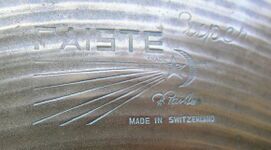
| − | + | *One of the stamps of this series (there are two distinct styles) still looks very similar to the [https://www.cymbal.wiki/wiki/Paiste_Stambul STAMBUL series] stamp. The Super formula series with the Stambul style logo seems to come in two versions: one with Formula 602 label and one without (see below).<br> | |
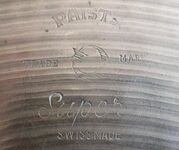
| − | + | *There are also two versions of the second style which looks like the early formula 602 stamp: one has the word "Super" written to the upper right ("plain stamp- Super"), the second variation does not have the word "Super" (we call this the "plain stamp"), both leave off the words "formula 602" these variations are thought to represent the evolution of the trademark for the super formula 602 series just as it was coming out.<br> | |
| − | + | *It is speculated that the "Super formula" term comes from the process that Swissmetal used to heat, mix, pour and hot roll the B20 alloy.<br> | |
| − | There are also two versions of | ||
| − | |||
| − | |||
Note: There is an entirely separate series called [http://www.cymbal.wiki/wiki/Paiste_Super#Super Super] which is not made from B20 alloy and came later. This has caused a lot of confusion over the years.<br> '''Sound sample:''' [https://youtu.be/Gb_Gl0xqbJs<b>Super Formula 24" ride</b>]<br> | Note: There is an entirely separate series called [http://www.cymbal.wiki/wiki/Paiste_Super#Super Super] which is not made from B20 alloy and came later. This has caused a lot of confusion over the years.<br> '''Sound sample:''' [https://youtu.be/Gb_Gl0xqbJs<b>Super Formula 24" ride</b>]<br> | ||
| − | <gallery | + | <gallery caption="Super Formula 602" heights="100" mode="packed"> |
| − | |||
| − | |||
| − | |||
| − | |||
| − | |||
| − | |||
| − | |||
File:Paiste 57-59 catalog 1.jpg|'59-'62 catalogs | File:Paiste 57-59 catalog 1.jpg|'59-'62 catalogs | ||
File:Paiste 57-59 catalog 2.jpg|'59-'62 catalogs | File:Paiste 57-59 catalog 2.jpg|'59-'62 catalogs | ||
File:Paiste 1959 63 catalog back cover.jpg|'59-'62 catalogs | File:Paiste 1959 63 catalog back cover.jpg|'59-'62 catalogs | ||
| + | File:Paiste Super Stambul Standard ad (Melos 1962).jpg|The super formula 602 is still listed in "Melos" magazine in 1962 | ||
| + | File:Super 602 blank logo 1.jpg| "plain stamp" | ||
| + | File:Paiste-SuperF602-gen2-logo.jpg||"plain stamp-Super" | ||
| + | File:Paiste-22-2794-stamp.jpg|"Super only" Stambul stamp | ||
| + | File:Early 602 super stambul type logo.jpg|"Super formula" Stambul stamp | ||
| + | </gallery> | ||
| + | <gallery caption="Examples" heights="100" mode="packed"> | ||
| + | File:602 14 super thinsm.jpg|14" "Super formula" Stambul stamp | ||
| + | File:Super 602 15 thin.jpg|15" "Super formula" Stambul stamp | ||
| + | File:Paiste-SuperF602-gen2-top.jpg|15" "plain stamp" | ||
| + | File:PXL 20221112 030503044.jpg|15" "plain stamp" hi hats | ||
| + | File:Paiste-602-super-top.jpg|"Super formula" Stambul stamp | ||
| + | File:16 super formula 2.jpg|16" "Super only" Stambul stamp | ||
| + | File:18 super formula stambul stmp.jpg|18" "Super formula" Stambul stamp | ||
| + | File:Paiste-pre602-top.jpg|22" "plain stamp" 602 Cymbal 22" | ||
| + | File:Cleaned super formulas.jpg| Stambul stamp and plain stamp comparison | ||
| + | File:Super x plain stamp location.jpg|Plain stamp location comparison | ||
</gallery> | </gallery> | ||
=== Preserial Era (~1962/63 - 1971/72)=== | === Preserial Era (~1962/63 - 1971/72)=== | ||
This is the first true era of the Formula 602 series. | This is the first true era of the Formula 602 series. | ||
| − | ==== Early "E over trade" stamp (~ | + | ==== Early "E over trade" stamp (~1962 to about 1965)==== |
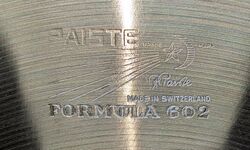
| − | This early era is | + | This early era is identified by several cymbals with these stamps that we have observed and or own, the "E over trade stamp" is the first stamp Paiste used on the early formula 602 series. It is relatively easy to spot the difference between this early stamp the perserial "Solid stamp" and 1970's "Outline stamp" formats. |
| − | + | The discovery of the early 60's logos illustrated in the catalogs below helped confirm the difference.<br> | |
| − | <gallery> | + | The E over trade stamp has two subtle variations (see pictures below), one version has a wide gap between "Formula 602" and "made in Switzerland" and the other has a much smaller gap. Also, the size of the text in general is smaller and or a different font on the "wide gap stamp" (see side by side comparison below).<br> |
| + | The 602 "Aribiter custom" was also produced during this period and possibly extended into the "solid stamp" era. | ||
| + | <gallery caption="E over Trade" heights="100" mode="packed"> | ||
File:63 catalog 20.jpg|~1963 catalog showing the original "E over trade" logo | File:63 catalog 20.jpg|~1963 catalog showing the original "E over trade" logo | ||
| − | File:Paiste | + | File:Paiste 1963 catalog a.jpg|~1963 catalog showing the original "E over trade" logo |
| − | File:Paiste-early-602- | + | File:Paiste-early-602-stamp3.jpg| "E over trade" small gap stamp |
| − | File: | + | File:PXL 20221029 234009393.jpg| "E over trade" large gap stamp |
| − | + | File:Large gap small gap.jpg| large gap/small gap comparison | |
| − | + | File:602 preserial stamps.jpg|E over trade and solid stamp comparison | |
| − | + | File:602 18 e over trade 2.jpg|18 medium | |
| − | + | File:PXL 20221029 233944523.jpg|22" medium ride | |
| − | + | File:Arbiter 602.jpg|Arbiter "Custom" stamp | |
| − | + | </gallery > | |
| − | ==== Solid Stamp (~1965 - mid 1972)==== | + | ==== Solid Stamp (~1965 - early/mid 1972) ==== |
| − | + | In simplest terms, the name "solid stamp" comes from the solid block letters that comprise the words "Paiste and "Formula 602", this stamp was used roughly from 1965 to 1972.<br> | |
| − | + | The earliest example we have seen of the Solid Stamp is from a 1965 catalog shown below. We believe the change of stamp coincided with Ludwig taking over North American distribution in late 1964/early 1965.<br> | |
| − | + | There are some exceptions where a cymbal was made during the preserial era and stamped with a "solid stamp" and ink, then the cymbal sat in the vault for a few years, the cymbal was then stamped with a serial number when it was shipped to the distributor (see example below).<br> | |
| − | + | <gallery caption="Solid Stamp" heights="100" mode="packed"> | |
| − | <gallery> | + | File:Paiste 1965ish catalog 1.jpg| ~1965 catalog |
| − | File:Paiste | ||
| − | |||
File:Paiste 63 catalog 2.jpg|1965 catalog showing "modern" stamp format | File:Paiste 63 catalog 2.jpg|1965 catalog showing "modern" stamp format | ||
| + | File:Paiste-602-solid.jpg|annotated solid stamp | ||
| + | File:Paiste-18-1510-stamp.jpg|solid stamp | ||
| + | File:Solid stamp b.jpg| | ||
| + | File:PXL 20230528 003028603.jpg| | ||
| + | File:602 preserial stamps.jpg|E over trade and solid stamp comparison | ||
| + | File:PXL 20221228 020839223.jpg|solid stamp with 1974 serial number | ||
| + | File:602 transition ink.jpg|close up of solid stamp | ||
| + | File:23 Heavy 2.jpg | ||
</gallery> | </gallery> | ||
| − | + | === Black Label Era (1972 -1981) === | |
| − | + | There are two different embossed stamps which are found in this era: solid stamp early on and then the outline stamp for the rest of the era. then there are two oddities: an archaic "E over trade" stamp for German 602's and the super formula stamp "plain stamp" for Rogers distributed dark rides).<br> | |
| − | + | This era represents cymbals produced from about mid 1972 to mid 1981 before colored labels were silkscreened on the top and bottom. Almost all Black Label era cymbals have serial numbers but there are a few examples of cymbals from the early 1970s which have Black Label style ink but no serial number. <br><br> | |
| − | === Black Label Era (1972 -1981)=== | + | ==== Outline Stamp (1972-1981) ==== |
| − | There are | ||
| − | |||
| − | |||
| − | ==== Outline Stamp (1972-1981)==== | ||
The Outline Stamp is used from just before serial numbers appear until the Blue Label era (1981). If you see a Formula 602 cymbal with an Outline Stamp it is something like 99% likely to have a serial number. | The Outline Stamp is used from just before serial numbers appear until the Blue Label era (1981). If you see a Formula 602 cymbal with an Outline Stamp it is something like 99% likely to have a serial number. | ||
| − | + | <gallery caption="Outline Stamp" heights="100" mode="packed"> | |
| − | <gallery> | ||
| − | |||
File:Paiste-602-outline-stamp.jpg|Annotated Outline Stamp | File:Paiste-602-outline-stamp.jpg|Annotated Outline Stamp | ||
| + | File:Outline stamp b.jpeg|1980 | ||
| + | File:PXL 20230528 055608775.jpg|1976 | ||
| + | File:PXL 20230528 055717280.jpg|1975 | ||
| + | File:PXL 20230528 055759138.jpg|1980 | ||
| + | File:Solid vs outline stmp.jpg|solid stamp/outline stamp comparison | ||
| + | File:PXL 20230529 021307993.jpg|solid stamp/outline stamp comparison | ||
| + | </gallery> | ||
| + | ==== Rogers U.S. 602 Dark Ride '76-'77 and European 602 version 1975-1978 ==== | ||
| + | The super formula 602 "plain stamp" appears on Rogers U.S. distributed Dark Rides from 1976-1977 this stamp does not have the "Formula 602" on the bottom of the stamp. So far every Rogers U.S dark ride cymbal we have seen has a serial number.<br> | ||
| + | We have also observed sor far from dozens of examples that all European distributed dark rides were stamped with the standard "outline stamp" from the black label era ('72 -'81), in addition, with a few exceptions all have the "Formula 602" ink printed above the bell.<br> | ||
| + | We are not certain if any of the "outline stamp" versions were sold in the US, research is ongoing![https://www.cymbal.wiki/wiki/Paiste_Formula_602_22%22_Dark_Ride <b>More on the Dark ride page!</b>] | ||
| + | <gallery caption="602 Dark ride" heights="100" mode="packed">> | ||
| + | File:Super formula plain stamp.jpg|The super formula 602 "plain stamp" is identical to the stamp used on the Rogers 602 dark rides! | ||
| + | File:Paiste-602-Trans-Dark-stamp.jpg|Rogers stamp: E over trade/plain stamp | ||
| + | File:Paiste-602-Dark-stamp.jpg|European Dark Ride: "outline stamp" | ||
| + | File:Trans 602 22 dark ride stamps.jpg|Rogers stamp: E over trade/plain stamp | ||
| + | File:602 22 dark ride.jpg|E over trade/plain stamp | ||
| + | File:Paiste-602-Trans-Dark-top.jpg|E over trade/plain stamp | ||
| + | File:22 dark 4.jpg|European dark ride with outline stamp | ||
| + | File:22 dark 2.jpg|European dark ride outline stamp | ||
| + | File:349227047 214684508023232 989629301524005366 n.jpg|selection of European dark rides stamped with the standard "outline stamp", bottom right 2 cymbals are early Sound creations | ||
</gallery> | </gallery> | ||
| + | ==== German 602's (early 1960's and mid 1970's?) ==== | ||
| + | We know the German factory "finished" 602's in the early/mid 60's when production was ramping up: | ||
| − | + | (**) Correspondence with Paiste Switzerland:<br> | |
| − | + | <i>"By reason of a distributed capacitance, we have some Formula 602's that have been finished in Germany at the end of the 1950's.<br> | |
| − | <gallery> | + | They were annealed and hammered in Switzerland and Paiste Germany has completed them. That’s the reason they have a stamp “made in Germany”.<br> |
| − | File: | + | |
| − | File: | + | Kind regards, Customer Service Department<br> |
| + | Paiste Switzerland"</i><br><br> | ||
| + | |||
| + | In the 1970's, the German 602's were meant for the German market and probably certain countries in Central Europe and eastern Europe, everyone else got Swiss produced 602's. | ||
| + | We have found a return of German 602's from about 1975 to 1977, they can be identified from the archaic "E over trade" stamp (no "made in Switzerland") and a serial number starting with a "1". | ||
| + | <gallery caption="Made in West Germany" heights="100" mode="packed"> | ||
| + | File:German 602.jpg| 1960's German 602 | ||
| + | File:16 german 602.jpg|E over trade stamp W/O "made in Switzerland" | ||
| + | File:German 602 flat3.jpg|German made 7 sound set | ||
| + | File:German 602 flat2.jpg|1976 serial number | ||
| + | File:German 602 flat1.jpg|German flat rides had "made under license" under the patent numbers | ||
| + | File:German 602 stamp.jpg| | ||
| + | File:14-990-1000-serial.jpg|1975 serial | ||
| + | File:14-990-1000-top.jpg| | ||
| + | File:18-1510-side.jpg|Joe Morello 602 made in Germany! | ||
</gallery> | </gallery> | ||
| − | |||
=== Blue Label Era === | === Blue Label Era === | ||
During the Blue Label era (1981-1993) an embossed stamp was no longer applied. Instead Paiste used blue ink. | During the Blue Label era (1981-1993) an embossed stamp was no longer applied. Instead Paiste used blue ink. | ||
| − | + | <gallery caption="Blue Label" heights="150" mode="packed"> | |
| − | <gallery> | ||
File:Paiste-16-1089-ink.jpeg|Blue ink 602 Logo | File:Paiste-16-1089-ink.jpeg|Blue ink 602 Logo | ||
File:Paiste-16-1089-inkb.jpeg|Blue ink pAisTe on bottom | File:Paiste-16-1089-inkb.jpeg|Blue ink pAisTe on bottom | ||
| Line 228: | Line 258: | ||
File:Paiste-16-1089-top.jpg|Top view | File:Paiste-16-1089-top.jpg|Top view | ||
</gallery> | </gallery> | ||
| − | + | [[File:Plasko thin crashes.jpg|1700px|]] | |
| − | We | + | <br><br> |
| − | + | We estimate the year of change from PreSerial to Black to Blue based on the serial numbers we find:<br> | |
Black label serial numbers (counting hat pairs as 2)<br> | Black label serial numbers (counting hat pairs as 2)<br> | ||
<br> | <br> | ||
| Line 262: | Line 292: | ||
1991: 2<br> | 1991: 2<br> | ||
1992: 4<br> | 1992: 4<br> | ||
| − | 1993: none so far<br> | + | 1993: none so far<br><br> |
| − | |||
Note the importance of the prefix. Without the PAISTE 602 prefix that one 1982 Black Label cymbal would have been 1972. If that serial number had prefix pAisTe it would be 1992. Prefix matters, although there are sometimes other ways to correctly assign the decade based on ink and for specific models. If the serial number has a prefix above it -- pay attention. That's what makes the decade (thus the whole serial number) unique. We think the myth of serial numbers starting in 1970 arose because people were not paying proper attention to the prefix. The other contributing factor is not treating the German made serial numbering separately. | Note the importance of the prefix. Without the PAISTE 602 prefix that one 1982 Black Label cymbal would have been 1972. If that serial number had prefix pAisTe it would be 1992. Prefix matters, although there are sometimes other ways to correctly assign the decade based on ink and for specific models. If the serial number has a prefix above it -- pay attention. That's what makes the decade (thus the whole serial number) unique. We think the myth of serial numbers starting in 1970 arose because people were not paying proper attention to the prefix. The other contributing factor is not treating the German made serial numbering separately. | ||
| − | |||
=== Laser Stamp Era === | === Laser Stamp Era === | ||
When the Formula 602 cymbals were reissued in 2011 they first came out with 8 digit serial numbers as seen on the last of the Blue Label cymbals. Very soon after this Paiste switched to a laser stamp which is on the bottom rather than the top. The Laser Stamp Era is also referred to as the Reissue Era, although once again there are a very few Reissued Formula 602s which don't have a laser stamp. | When the Formula 602 cymbals were reissued in 2011 they first came out with 8 digit serial numbers as seen on the last of the Blue Label cymbals. Very soon after this Paiste switched to a laser stamp which is on the bottom rather than the top. The Laser Stamp Era is also referred to as the Reissue Era, although once again there are a very few Reissued Formula 602s which don't have a laser stamp. | ||
| − | + | <gallery caption="Laser Stamp" heights="200" mode="packed"> | |
| − | <gallery> | ||
File:Paiste-602-2011-serial.jpg|2011 embossed serial | File:Paiste-602-2011-serial.jpg|2011 embossed serial | ||
File:Paiste-602-laser-stamp.jpg|Laser stamp from 2015 | File:Paiste-602-laser-stamp.jpg|Laser stamp from 2015 | ||
</gallery> | </gallery> | ||
| − | |||
<br><br> | <br><br> | ||
-------- | -------- | ||
| − | Information from: Steve Black, the majority of the individual cymbal model/size pictures courtesy of "Splash Baker" and her blue label collection.<br> | + | Information/research from: Steve Black, Todd Little, Dan Garza, the majority of the individual cymbal model/size pictures courtesy of "Splash Baker" and her blue label collection.<br> |
#Modern Drummer Equipment Annual 1988-89<br> | #Modern Drummer Equipment Annual 1988-89<br> | ||
#PAISTE/Ludwig Seven Sound Set Leaflet<br> | #PAISTE/Ludwig Seven Sound Set Leaflet<br> | ||
Latest revision as of 00:34, 16 January 2026
Formula 602
Contents
- 1 Formula 602
- 2 Formula 602 Modern Essentials
- 3 Production Eras


Introduction: 1962/63ish (based on advertising and catalogs)
Discontinued: 1994 (based on serial numbers) then reissued 2011 to present
Background: One of the world’s most revered and legendary cymbal lines in history, renown and loved for its fine, delicate musical tone.
Robert Paiste had been experimenting with cymbals made of B20 bell bronze starting in 1957, this (new to Paiste) B20 alloy first came onto the market under the name "SUPER FORMULA 602" the predecessor to the Formula 602. It is believed that Robert spent a couple of years refining the production process ('57-'59), sound characteristics and model names and sizes, then we think the "Super Formula" series ran to about 1962. Evidence shows that the Formula 602 series became available in 1962 and was produced until Paiste's B20 supplier Swissmetal ran into financial difficulties and stopped production of blanks in 1994.
Innovation: Second B20 cymbal made by Paiste, the Formula 602 line also saw the introduction of the Sound Edge Hi-Hat, the Flatride, China Type with a Turkish bell, Splash and Bell.
Alloy: B20 Bronze, also known as "Bell Bronze".
Quality: Professional
Offered as: Formula 602 - Formula 602 Modern Essentials
Production: Manually machine hammered, fine tuned with hand hammering and hand lathed B20 bronze.
Applications: Most volume settings • Low to medium loud settings • especially well-suited for recording, live • Jazz, Fusion, Blues, Pop and Rock, Country, Folk, acoustic music.
Users: Professional musicians, refined drummers and sound specialists with precise requirements that need a fully developed character in their cymbal sound
Late 1960's early 1970's formula 602 users: Clive Bunker playing a shiny new set of 602's in 1970 @ the isle of Wight festival.

Sound:
- Musical, transparent, beautiful, rich, colorful, full, clear, expressive sound • The model range features everything from particularly delicate, well balanced and sensitive to expressive, potent and powerful and projective qualities
- Warm, silvery, mellow, cool, light, fine, precise and controlled • Cymbals with clarity and retro vintage character combined with a velvety, sensitive, very responsive feel. (4)
- Formula 602 sounds are very precise, very clear and very pure. They are suited to acoustic music, jazz, classical performances and recording. Only a delicate touch is required to produce their distinctive, cool and natural response. (1)
- Forged from the legendary «602 Bronze» (CuSn20), handcrafted from start to finish by highly skilled Swiss craftsmen, Formula 602 Classic Sounds cymbals produce a true, pure sound of unique clarity and consistency.
Formula 602 Models in Production
Rides
- Flatride Medium - 20"
- Flatride Thin - 18" 20" 22"
- Heavy - 16" 18" 20"
- Medium Ride - 20" 22" 24"
Crashes
Hi-Hats
Splashes (& Bells)
Discontinued Models & Sizes
Rides
- Dark Ride - 22"
- Flatride Heavy - 16" 18" 20" 22"
- Flatride Medium - 14" 16" 18" 22"
- Flatride Thin - 14" 16" 24"
- Heavy - 8" 10" 11" 12" 13" 14" 15" 17" 19" 21" 22" 23" 24" 26"
- Medium Ride - 16" 17" 18" 19" 21"
- Space Sound Medium - 18" 20"
- Space Sound Thin - 18" 20"
Crashes
- Medium - 10" 11" 12" 13" 14" 15" 21" 22" 23" 24" 26"
- Paperthin - 10" 11" 12" 13" 14" 15" 17" 19" 21" 22" 23" 24" 26"
- Thin - 10" 11" 12" 13" 14" 15" 16" 17" 18" 19" 20" 21" 22" 23" 24" 26" 28"
- Thin Crash - 12" 13" 14" 15" 21" 24" 26"
Hi-Hats
- Extra Heavy Hi-Hat - 11" 12" 13" 14" 15"
- Extra Heavy Sound Edge Hi-Hat - 13" 14" 15"
- Heavy Hi-Hat - 13"
- Hi-Hat - 13" 14" 15"
- Medium Hi-Hat - 13" 16" 17"
- Sound Edge Hi-Hat - 13"
Chinas (& Swishes)
Splashes (& Bells)
Other
- Cup Chime - 8" 10" 11"
- Concert - 17" 18" 19" 20"
- Concert Medium Weight - 17" 18" 19" 20" 21"
- Concert Medium-Heavy - 18" 19" 20"
- Concert Medium-Thin - 18" 19" 20"
- Concert Heavy - 17" 18" 19" 20"
- Crotale - 1 Octave Set 2 Octave Set 2½ Octave Set
- Concert Sound Edge - 18" 20"
- Marching - 12" 13" 14" 15" 16"
- Marching Sound Edge - 14" 15" 16" 18" 20"
Seven Sound Set


Introduction: 1967
Discontinued: 1977
Background: The following description of the Seven Sound Set was printed in Paiste's 1969 catalog:
"A set of seven cymbals each in a new unusual sound-color. Sound colors the demanding drummer is looking for to enrich his personal cymbal set. Particularly, the SEVEN SOUND SET enables the studio drummer to fulfill the many and often unusual sound demands involved in modern recording and studio work."
Flat ride Background: From a 2006 Robert Paiste interview: "The Flat Ride is the first and the last cymbal that more or less came out of a gag. That was with Joe Morello, he visited here once and at that time there were these new super thin Swiss watches, he was fascinated with his new super thin watch that he had just got. He said, "why don't you make a cymbal like that?" I wondered, what does a cymbal without a bell sound like? Well, we were making gongs, but I didn't relate to that, we built prototypes, which surprised us very much with the sound."
The very early versions or possibly prototypes were labeled "Space Sound" in medium (confirmed) and possibly thin weight. It also believed that less than a dozen of these were made before the name changed to "Flatride"
- 1 Bell - 8"
- 2 Splash - 11"
- 3 Bright Ride - 17"
- 4 Flatride Medium - 18"
- 4 Flatride Thin - 18"
- 5 Ride/Crash - 18"
- 6 China Type - 18"
- 7 Deep Ride - 18"
Joe Morello Set

Introduction: 1967ish - 1977 (based on serial numbers)
Discontinued: 1976
Background: "Late '65, early '66 after Ludwig took over the distribution of Formula 602's for North America, Joe Morello was approached by Bill Ludwig to endorse Paiste. Since Joe played and endorsed Ludwig Drums, he was the obvious choice for a signature cymbal set baring his name. Paiste catalog: "In personal collaboration with Joe Morello, this beautiful melodically coordinated set was created" A custom set of Formula 602 cymbals made to Joe's specification (the 1st. artist model!) comprising of 14" sound edge hi hats, 17", 18" and 20" sizes. Visual cues show much finer lathing and possibly different hammering compared to the standard 602's
Rides
Crashes
- Crash - 17"
- Crash/Ride - 18"
Hi-Hats
Formula 602 Modern Essentials


Introduction: 2013
Background: Forged from the legendary «602 Bronze» (CuSn20), offering a complete new wide and dynamic sound dimension, developed in close collaboration with Vinnie Colaiuta, handcrafted from start to finish by highly skilled Swiss craftsmen, conceived and executed according to Vinnie’s uncompromising sound concepts for a wide all-round application. Formula 602 Modern Essentials cymbals combine the essence of the Formula 602 Classic Sounds models – transparency and stick definition – with the richness, warmth, darkness and a bit of complexity of the Signature Traditionals series besides providing slightly more pizzazz than its Classic Sounds siblings.
Alloy: B20 (CuSn20)
Quality: Professional
Offered as: Formula 602 - Formula 602 Modern Essentials
Production: Hand hammered and hand lathed bronze.
Applications: Low to medium loud settings •especially well-suited for recording, live • extremely versatile cymbals for a wide range of music styles such as Pop, Rock, Jazz, Fusion, Blues, R&B, Country, Folk, acoustic music
Sound:Deep, full, rich, warm, lively, silvery, dynamic, controlled and precise • Cymbals that combine clarity, consistency with deepness and warmth, yet providing a modern versatile sound character with dynamic, potent, well balanced qualities and a responsive, soft feel
Rides
Crashes
Hi-Hats
Chinas (& Swishes)
Splashes (& Bells)
Production Eras
Super Formula 602 (1957/59 - 1963 according to advertising data)
Robert Paiste had been experimenting with cymbals made of B20 bell bronze starting in 1957 when he first opened the Swiss factory (at that point it was a one room shop!).
It should be noted that Robert founded the Swiss factory across lake Sempach from where their future B20 alloy supplier "Metallwerke Dornach/Swissmetal" was located (Paiste had not used B20 alloy up to that point, little did he know they were the only foundry and mill that produced B20 bronze in all of Switzerland and possibly all of western Europe!). He initially worked with Swissmetal and developed a process of rolling B20 thin enough for B20 cymbal production, Swissmetal previously had not rolled it to such a thin specification but did have the equipment to do it reliably, Robert literally had to teach the foundry technicians how to roll the blanks to his thin specification without cracking!
It is believed that Robert spent a couple of years refining the production process ('57-'59), sound characteristics and model names and sizes, this means that most likely the "Super formula" didn't reach widespread distribution until about 1959. This (new to Paiste) B20 alloy first came onto the market under the name "SUPER FORMULA 602".
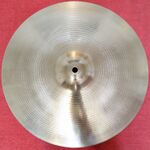
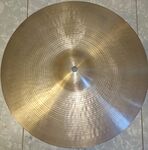
- One of the stamps of this series (there are two distinct styles) still looks very similar to the STAMBUL series stamp. The Super formula series with the Stambul style logo seems to come in two versions: one with Formula 602 label and one without (see below).
- There are also two versions of the second style which looks like the early formula 602 stamp: one has the word "Super" written to the upper right ("plain stamp- Super"), the second variation does not have the word "Super" (we call this the "plain stamp"), both leave off the words "formula 602" these variations are thought to represent the evolution of the trademark for the super formula 602 series just as it was coming out.
- It is speculated that the "Super formula" term comes from the process that Swissmetal used to heat, mix, pour and hot roll the B20 alloy.
Note: There is an entirely separate series called Super which is not made from B20 alloy and came later. This has caused a lot of confusion over the years.
Sound sample: Super Formula 24" ride
- Super Formula 602

'59-'62 catalogs

'59-'62 catalogs

'59-'62 catalogs

The super formula 602 is still listed in "Melos" magazine in 1962

"plain stamp"
"plain stamp-Super"
"Super only" Stambul stamp

"Super formula" Stambul stamp


.jpg)


- Examples
14" "Super formula" Stambul stamp
15" "Super formula" Stambul stamp
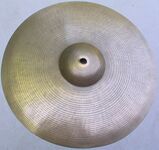
15" "plain stamp"
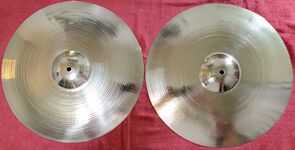
15" "plain stamp" hi hats
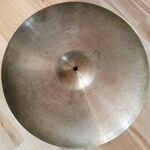
"Super formula" Stambul stamp
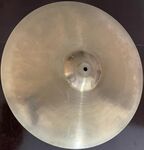
16" "Super only" Stambul stamp

18" "Super formula" Stambul stamp
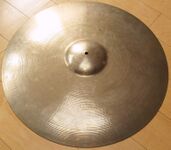
22" "plain stamp" 602 Cymbal 22"
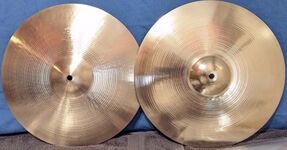
Stambul stamp and plain stamp comparison

Plain stamp location comparison


Preserial Era (~1962/63 - 1971/72)
This is the first true era of the Formula 602 series.
Early "E over trade" stamp (~1962 to about 1965)
This early era is identified by several cymbals with these stamps that we have observed and or own, the "E over trade stamp" is the first stamp Paiste used on the early formula 602 series. It is relatively easy to spot the difference between this early stamp the perserial "Solid stamp" and 1970's "Outline stamp" formats.
The discovery of the early 60's logos illustrated in the catalogs below helped confirm the difference.
The E over trade stamp has two subtle variations (see pictures below), one version has a wide gap between "Formula 602" and "made in Switzerland" and the other has a much smaller gap. Also, the size of the text in general is smaller and or a different font on the "wide gap stamp" (see side by side comparison below).
The 602 "Aribiter custom" was also produced during this period and possibly extended into the "solid stamp" era.
- E over Trade
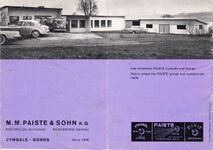
~1963 catalog showing the original "E over trade" logo

~1963 catalog showing the original "E over trade" logo
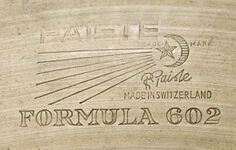
"E over trade" small gap stamp
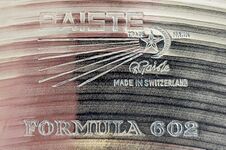
"E over trade" large gap stamp

large gap/small gap comparison
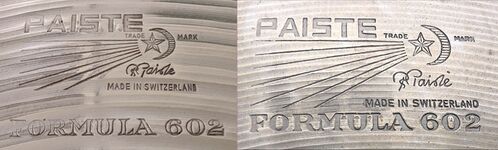
E over trade and solid stamp comparison

18 medium
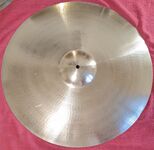
22" medium ride
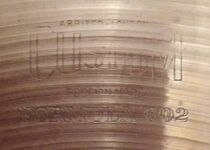
Arbiter "Custom" stamp


Solid Stamp (~1965 - early/mid 1972)
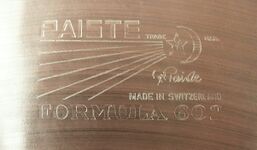
In simplest terms, the name "solid stamp" comes from the solid block letters that comprise the words "Paiste and "Formula 602", this stamp was used roughly from 1965 to 1972.
The earliest example we have seen of the Solid Stamp is from a 1965 catalog shown below. We believe the change of stamp coincided with Ludwig taking over North American distribution in late 1964/early 1965.
There are some exceptions where a cymbal was made during the preserial era and stamped with a "solid stamp" and ink, then the cymbal sat in the vault for a few years, the cymbal was then stamped with a serial number when it was shipped to the distributor (see example below).
- Solid Stamp

~1965 catalog
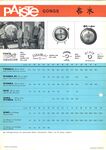
1965 catalog showing "modern" stamp format
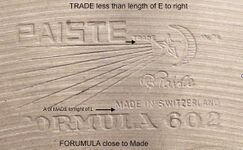
annotated solid stamp
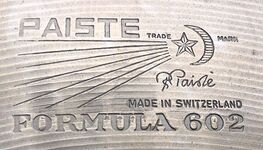
solid stamp
E over trade and solid stamp comparison
solid stamp with 1974 serial number
close up of solid stamp


Black Label Era (1972 -1981)
There are two different embossed stamps which are found in this era: solid stamp early on and then the outline stamp for the rest of the era. then there are two oddities: an archaic "E over trade" stamp for German 602's and the super formula stamp "plain stamp" for Rogers distributed dark rides).
This era represents cymbals produced from about mid 1972 to mid 1981 before colored labels were silkscreened on the top and bottom. Almost all Black Label era cymbals have serial numbers but there are a few examples of cymbals from the early 1970s which have Black Label style ink but no serial number.
Outline Stamp (1972-1981)
The Outline Stamp is used from just before serial numbers appear until the Blue Label era (1981). If you see a Formula 602 cymbal with an Outline Stamp it is something like 99% likely to have a serial number.
- Outline Stamp
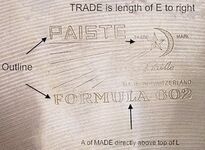
Annotated Outline Stamp
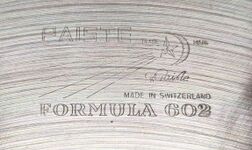
1980
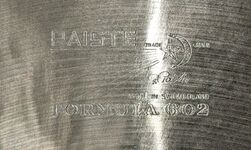
1976
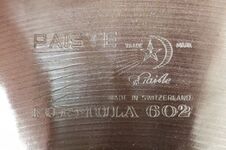
1975
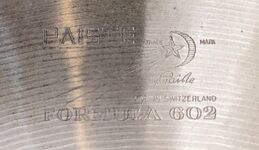
1980
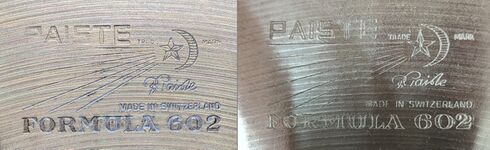
solid stamp/outline stamp comparison
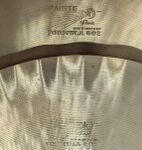
solid stamp/outline stamp comparison


Rogers U.S. 602 Dark Ride '76-'77 and European 602 version 1975-1978
The super formula 602 "plain stamp" appears on Rogers U.S. distributed Dark Rides from 1976-1977 this stamp does not have the "Formula 602" on the bottom of the stamp. So far every Rogers U.S dark ride cymbal we have seen has a serial number.
We have also observed sor far from dozens of examples that all European distributed dark rides were stamped with the standard "outline stamp" from the black label era ('72 -'81), in addition, with a few exceptions all have the "Formula 602" ink printed above the bell.
We are not certain if any of the "outline stamp" versions were sold in the US, research is ongoing!More on the Dark ride page!
- 602 Dark ride

The super formula 602 "plain stamp" is identical to the stamp used on the Rogers 602 dark rides!
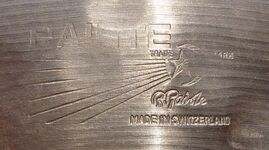
Rogers stamp: E over trade/plain stamp
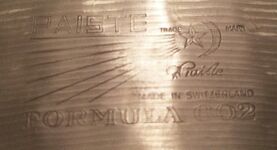
European Dark Ride: "outline stamp"

Rogers stamp: E over trade/plain stamp
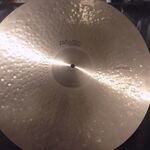
E over trade/plain stamp
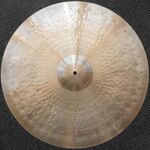
E over trade/plain stamp
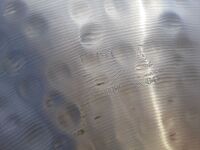
European dark ride with outline stamp
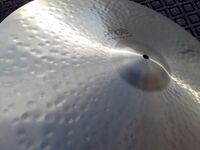
European dark ride outline stamp
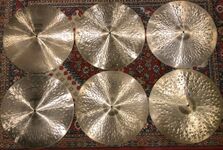
selection of European dark rides stamped with the standard "outline stamp", bottom right 2 cymbals are early Sound creations


German 602's (early 1960's and mid 1970's?)
We know the German factory "finished" 602's in the early/mid 60's when production was ramping up:
(**) Correspondence with Paiste Switzerland:
"By reason of a distributed capacitance, we have some Formula 602's that have been finished in Germany at the end of the 1950's.
They were annealed and hammered in Switzerland and Paiste Germany has completed them. That’s the reason they have a stamp “made in Germany”.
Kind regards, Customer Service Department
Paiste Switzerland"
In the 1970's, the German 602's were meant for the German market and probably certain countries in Central Europe and eastern Europe, everyone else got Swiss produced 602's. We have found a return of German 602's from about 1975 to 1977, they can be identified from the archaic "E over trade" stamp (no "made in Switzerland") and a serial number starting with a "1".
- Made in West Germany
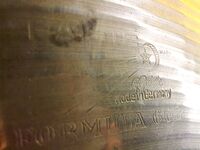
1960's German 602
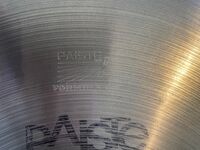
E over trade stamp W/O "made in Switzerland"
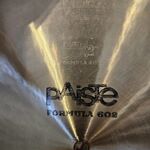
German made 7 sound set
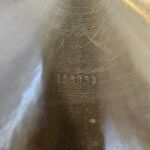
1976 serial number
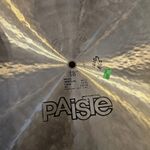
German flat rides had "made under license" under the patent numbers
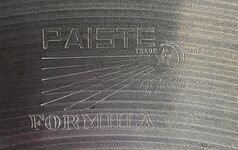
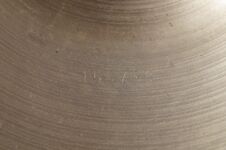
1975 serial
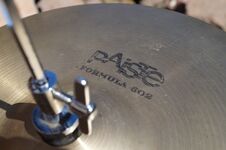
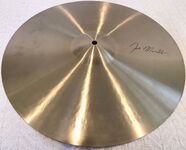
Joe Morello 602 made in Germany!


Blue Label Era
During the Blue Label era (1981-1993) an embossed stamp was no longer applied. Instead Paiste used blue ink.
- Blue Label
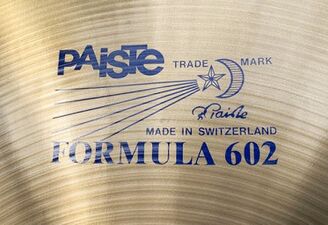
Blue ink 602 Logo
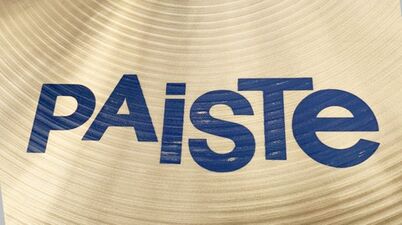
Blue ink pAisTe on bottom
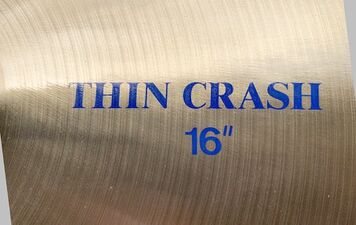
Blue model ink
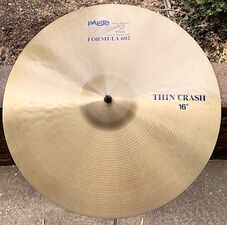
Top view


We estimate the year of change from PreSerial to Black to Blue based on the serial numbers we find:
Black label serial numbers (counting hat pairs as 2)
1971: none so far
1972: 29
1973: 40
1974: 41
1975: 27
1976: 26
1977: 32
1978: 37
1979: 28
1980: 18
1981: 18
1982: 1 (serial number PAISTE 602 / 238079)
1983: none so far
Blue label serial numbers (counting hat pairs as 2)
1980: none so far
1981: 32
1982: 23
1983: 17
1984: 19
1985: 15
1986: 13
1987: 12
1988: 21
1989: 8
1990: 9
1991: 2
1992: 4
1993: none so far
Note the importance of the prefix. Without the PAISTE 602 prefix that one 1982 Black Label cymbal would have been 1972. If that serial number had prefix pAisTe it would be 1992. Prefix matters, although there are sometimes other ways to correctly assign the decade based on ink and for specific models. If the serial number has a prefix above it -- pay attention. That's what makes the decade (thus the whole serial number) unique. We think the myth of serial numbers starting in 1970 arose because people were not paying proper attention to the prefix. The other contributing factor is not treating the German made serial numbering separately.
Laser Stamp Era
When the Formula 602 cymbals were reissued in 2011 they first came out with 8 digit serial numbers as seen on the last of the Blue Label cymbals. Very soon after this Paiste switched to a laser stamp which is on the bottom rather than the top. The Laser Stamp Era is also referred to as the Reissue Era, although once again there are a very few Reissued Formula 602s which don't have a laser stamp.
- Laser Stamp
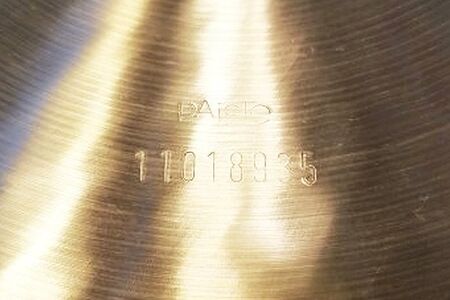
2011 embossed serial
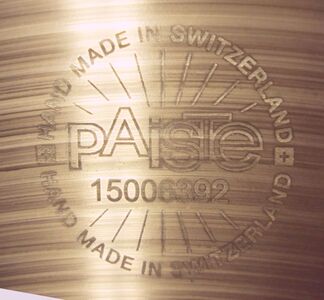
Laser stamp from 2015


Information/research from: Steve Black, Todd Little, Dan Garza, the majority of the individual cymbal model/size pictures courtesy of "Splash Baker" and her blue label collection.
- Modern Drummer Equipment Annual 1988-89
- PAISTE/Ludwig Seven Sound Set Leaflet
- Paiste "Six Cymbal Lines" Ad 1981
- 2019 PAISTE.com
Back to Paiste Series Portal
Back to Paiste Cymbal Type Portal
Back to Paiste Portal
